 Guide
GuideGundam Scales Explained: 1/144 vs 1/100 vs 1/60
Scale trips up more new builders than anything else in this hobby. You see a kit listed at 1/144 and another at 1/100 and have no real sense of how different they will look sitting next to each other until a box shows up smaller (or bigger) than you expected.
Scale and grade are two separate systems that happen to line up most of the time, and once that clicks, picking kits gets a lot easier. I want to walk through what each scale actually measures, how it maps to the grade lines you already see everywhere on this site, and how to think about shelf space before your cart fills up with kits that do not fit together the way you pictured.
This is the companion piece to the grades breakdown, so if you have not sorted out HG from MG from PG yet, start there and come back to this for the size math.
What the scale number actually means
The fraction is a ratio to the mobile suit's in-universe height. A kit at 1/144 scale is built at one 144th the size of the full mecha as described in its show or game. A kit at 1/60 is much closer to full size on paper, one 60th, which is why it ends up so much taller in your hands.
Most mainline Gundams are written as roughly 18 meters tall, and that number is what the scale math runs against. A taller mobile suit like some of the bigger Unicorn-era or Turn A designs will come out taller than a standard kit even at the same scale, so scale tells you the ratio, not a fixed height. Treat the numbers below as the useful average, not a law.
1/144: the small-shelf scale
A standard 18 meter Gundam at 1/144 lands around 5 to 6 inches tall once built. This is the scale HG and RG both use, which is part of why a Real Grade and a High Grade of the same mobile suit sit at almost identical height on a shelf even though the RG usually has tighter proportions and more internal frame.
1/144 is where most people start and where most people stay, because you can fit a real squad of kits in the space one MG would take. If you are building a whole faction, a battle diorama, or just do not have a dedicated display case yet, this is the scale that scales with your space, no pun intended, but it is true.
1/100: the detail-and-size middle ground
1/100 kits (mainly MG, plus the RE/100 line) run about 7 to 10 inches for a standard-height mobile suit. That jump from 1/144 gives designers more physical plastic to work with, which is why Master Grade kits can pack in inner frames, opening hatches, and panel detail that a same-price HG cannot physically fit.
The tradeoff is obvious once you have a few on a shelf: an MG takes up roughly the footprint of two or three HGs. If your collection is mostly 1/144 and you want to feature one or two hero units at a noticeably bigger, more detailed build, 1/100 is usually the jump people make first.
1/60: display-piece territory
1/60 is Perfect Grade's scale, and a standard Gundam here comes in around 12 inches tall, sometimes more depending on the mobile suit. At this size the kit stops being a shelf piece among many and becomes a centerpiece on its own, often with full internal frames, lit-up gimmicks, and a part count that turns a build into a multi-day project.
Think about clearance before you commit. A 12 inch kit needs real vertical room, and depending on the mobile suit's proportions (backpacks, wings, weapons) the footprint can end up wider than you expect too.
How scale maps to grade (and where it does not line up cleanly)
HG and RG share 1/144. MG sits at 1/100. PG sits at 1/60. That covers the vast majority of kits you will run into. Where it gets messier is SD, which drops scale accuracy entirely in favor of a chibi, oversized-head style built more for cost and character than any real ratio, and EG, which is 1/144 but built to a simpler, cheaper engineering standard than HG.
So grade tells you about engineering complexity and price point, while scale tells you about physical size. They correlate strongly (higher grades generally mean bigger scale) but they are answering different questions. If you want the deeper breakdown of what separates HG, RG, MG, PG, SD, and EG on build complexity, that is a separate guide worth reading before you commit to a grade line.
Planning your shelf before you buy
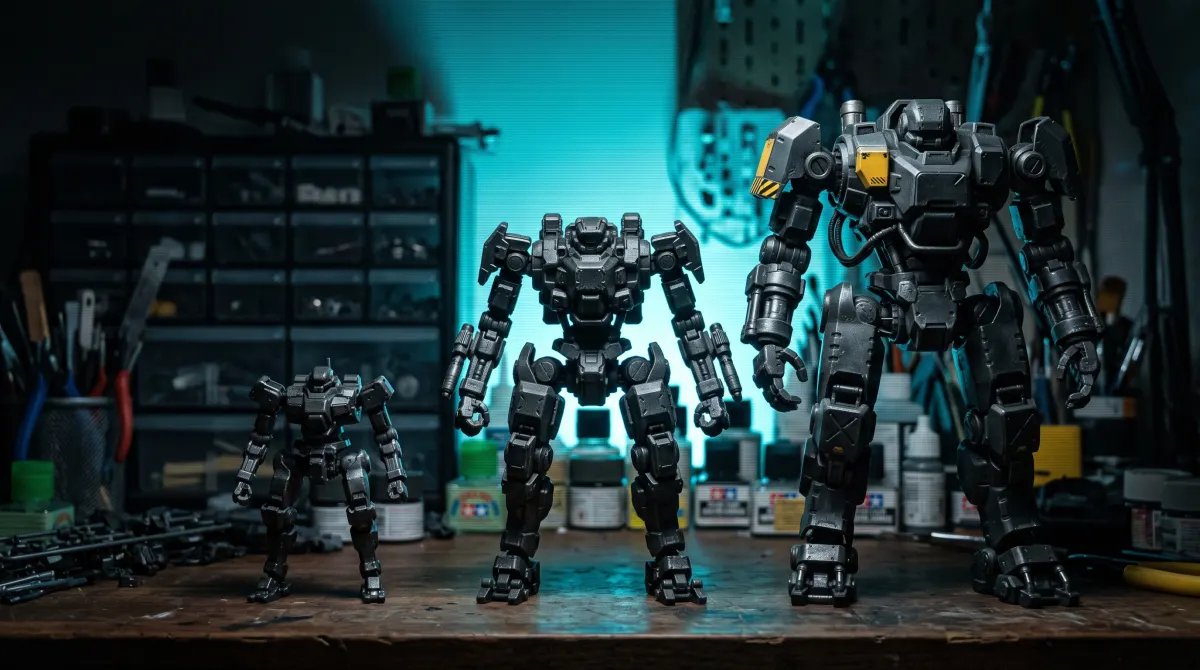
Mixed-scale shelves are common and fine, but they read as intentional when you group by scale rather than scatter kits randomly. A row of 1/144 kits next to each other looks like a matched squad. Drop a single 1/100 in the middle of that row and it can look like an odd size jump rather than a deliberate feature piece.
A rough rule that works for a lot of builders: use 1/144 for anything you want in volume (full mobile suit teams, rival factions, army builds), reserve 1/100 for units you want to stand out with more detail, and save 1/60 for the one or two mobile suits you actually love enough to give a dedicated spot to. Measure your shelf depth before ordering a PG especially, since the box art rarely makes clear just how much space 12 inches of Gundam actually needs.
Scale tells you how big a kit will be on your shelf (1/144 around 5 inches, 1/100 around 7 to 10, 1/60 around 12), while grade tells you how it is engineered, and knowing both before you buy saves you from a display case that does not fit together the way you pictured.
Common questions
Is a bigger scale always a better kit?
No. Scale is about physical size, not build quality. A well-engineered RG at 1/144 can out-detail a cheaper 1/100 kit. Bigger scale generally means more parts and more display presence, not automatically a better build experience.
Can I display 1/144 and 1/100 kits together?
Yes, plenty of collections mix scales. It reads best when you group kits by scale within a shelf rather than alternating sizes, so the height difference looks intentional instead of random.
Why do HG and RG look the same size but feel so different to build?
They share 1/144 scale, so the finished height is nearly identical, but RG packs in a miniaturized inner frame and finer part breakdown that HG does not attempt, which is a grade difference, not a scale difference.
Does every 1/144 kit come out around 5 inches?
Only for standard-height mobile suits. Taller designs in the source material will produce taller kits even at the same 1/144 ratio, so always check the listed kit height rather than assuming from scale alone.