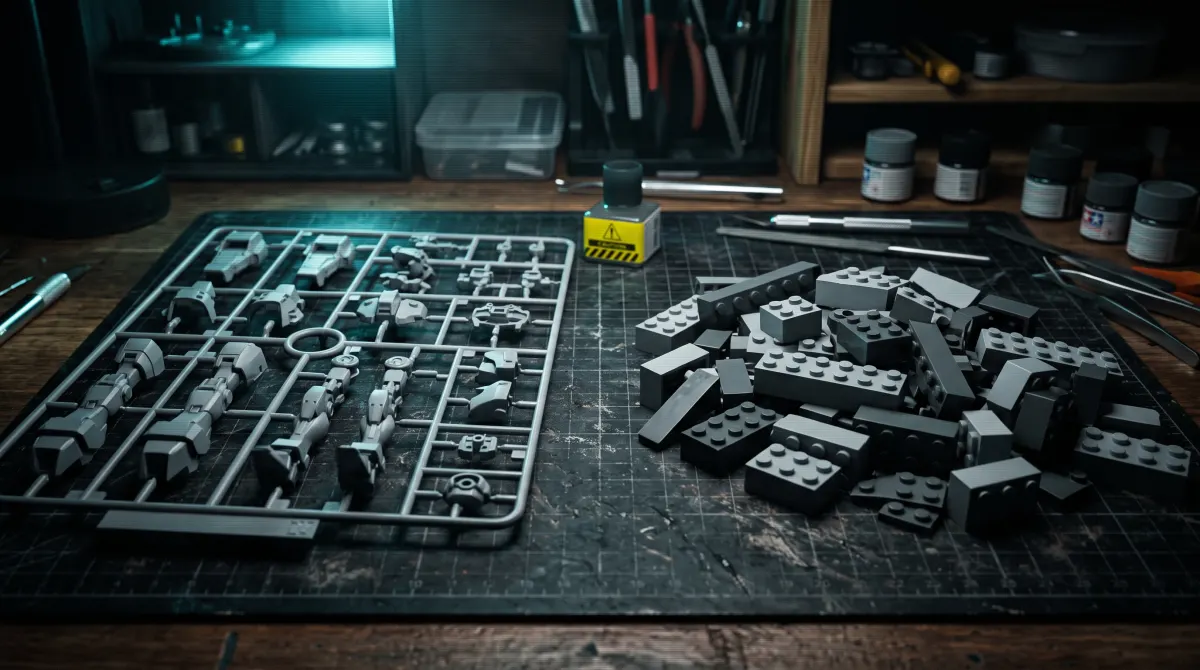
 Guide
GuideGunpla vs Lego: Which Should You Build?
I get asked this a lot by people who grew up on Lego and are eyeing a Gundam kit for the first time, or the other way around, a longtime gunpla builder wondering if Lego Technic is worth a look. The honest answer is that they are not really competitors. They are two different hobbies that happen to share a shelf.
Both use snap-fit construction, so nobody needs to touch glue to finish either one. Past that, the parts count, the articulation, the display goals, and even the mindset you bring to the table diverge fast. I have built a lot of both over the years, and I want to walk through where each one wins so you can figure out which fits the way you actually want to spend an evening.
This is not a hobby is better than the other argument. It is a practical breakdown of cost, tools, display space, and what the actual building session feels like, so you can pick the right first kit instead of guessing.
Cost per kit
A standard HG gunpla kit runs roughly $12 to $35 for a 1/144 scale Gundam with 60 to 200 parts, and that price includes a fully color-molded, poseable, finished figure straight out of the box. Lego sets scale wildly by piece count and license, but a comparably sized Technic or licensed set with moving parts tends to land in a similar range or higher once you factor in exclusive pieces and minifigures.
Where gunpla pulls ahead on value is that the sticker price is close to the final cost. You do not need extra parts to make an HG kit look finished. Lego sets, especially display-focused ones, often tempt you into buying a second set for spare parts or a display case, which adds up.
Tools and glue
Neither hobby requires glue for a basic build. Every modern Bandai gunpla kit is snap-fit, and so is essentially every current Lego set. That is the one place these two hobbies genuinely agree.
Where they split is what happens after the box opens. Gunpla benefits enormously from a pair of proper nippers to clip parts cleanly off the runner, because Lego pieces come pre-finished while gunpla parts still carry small nub marks that a plain thumb-twist leaves visible. You can build a gunpla kit with nothing but your hands, but a five dollar pair of nippers changes the whole experience. Lego needs zero tools at all, which is part of why it is the easier on-ramp for a kid or a first-timer.
The building experience itself
This is where the two hobbies really part ways. Lego building is additive and forgiving. You stack, you can undo a mistake in seconds, and the process is as much about the picture in the instructions as the mechanism underneath.
Gunpla building is closer to precision assembly. Parts are smaller, runners need to be clipped in the right order, and a lot of the satisfaction comes from watching a shoulder joint or a chest frame come together as an internal skeleton before the armor panels snap over it. It asks for more focused attention in shorter bursts rather than a long relaxed session, and mistakes (a part put on backwards, a joint forced the wrong way) are less forgiving to reverse than pulling apart a Lego brick.
Articulation and posing
This is the category where gunpla simply does something Lego cannot. Even an entry-level HG kit has working knee, elbow, and hip joints built into an internal frame, so the finished model can hold a running pose, a weapon stance, or a dynamic action shot on a shelf. Lego figures, minifigures included, are limited to a handful of pivot points and were never engineered for that kind of dynamic posing.
If what you want at the end of the build is something you can pose and photograph like a small action figure, gunpla wins outright. If what you want is a static model or a functioning mechanism (a working crane arm, a car with steering), Lego Technic is built for that instead.
Display space and durability
A finished HG or RG gunpla stands 5 to 6 inches tall and takes up very little shelf space, which is part of why builders end up with rows of them. Larger grades like MG and PG take more room and are heavier in the hand, but even those stay compact next to a Lego display build.
Lego sets, especially in the Icons or Technic ranges, tend to be bulkier and can be more structurally fragile at the joints over time if you move them around. Gunpla joints are designed for repeated posing and generally hold tension better across years of handling, though loose joints on older or heavily posed kits are a known issue builders solve with joint tightening techniques.
Who each one actually suits
If you like a relaxed, no-pressure build where the end result is a display piece or a set piece for a bigger collection, and you do not need dynamic posing, Lego is the more forgiving entry point and works well for building with kids.
If you want a compact, poseable figure with real engineering underneath, and you enjoy a build that rewards patience and a steady hand in a shorter session, gunpla is going to click with you fast. A lot of builders end up doing both. They are not mutually exclusive hobbies, they just scratch different itches on the same shelf.
Lego and gunpla both snap together without glue, but gunpla wins on poseable articulation and compact display value, while Lego wins on ease and forgiving, tool-free building.
Common questions
Do gunpla kits need glue like older plastic models?
No. All current Bandai gunpla kits are snap-fit and build without any glue. Cement is only used by advanced builders for optional seam work, never for basic assembly.
Is gunpla harder to build than Lego?
It asks for more precision and focus per part, since pieces are smaller and joints need to seat correctly, but a beginner-friendly HG kit is still approachable in an evening with just a pair of nippers.
Which is cheaper, gunpla or Lego?
A comparable HG gunpla kit usually costs $12 to $35 and needs nothing extra to look finished, which often makes it the better per-dollar value than a similarly sized Lego display set.