 Guide
GuideGunpla Tools You Actually Need to Start
Every gear shop page makes it look like Gunpla needs a full workbench before you can touch a runner. It does not. I have built plenty of kits with almost nothing and plenty more with a drawer full of gear, and the gap between those two builds is smaller than the shopping carts suggest.
What actually matters is a short list, and most of it is cheap. A couple of items earn their price the first time you use them and never leave your desk again. A few more are nice once you are hooked but will not make or break kit number one.
This is that list, split honestly into what you need before you open the box and what can wait.
The one tool that changes everything: nippers
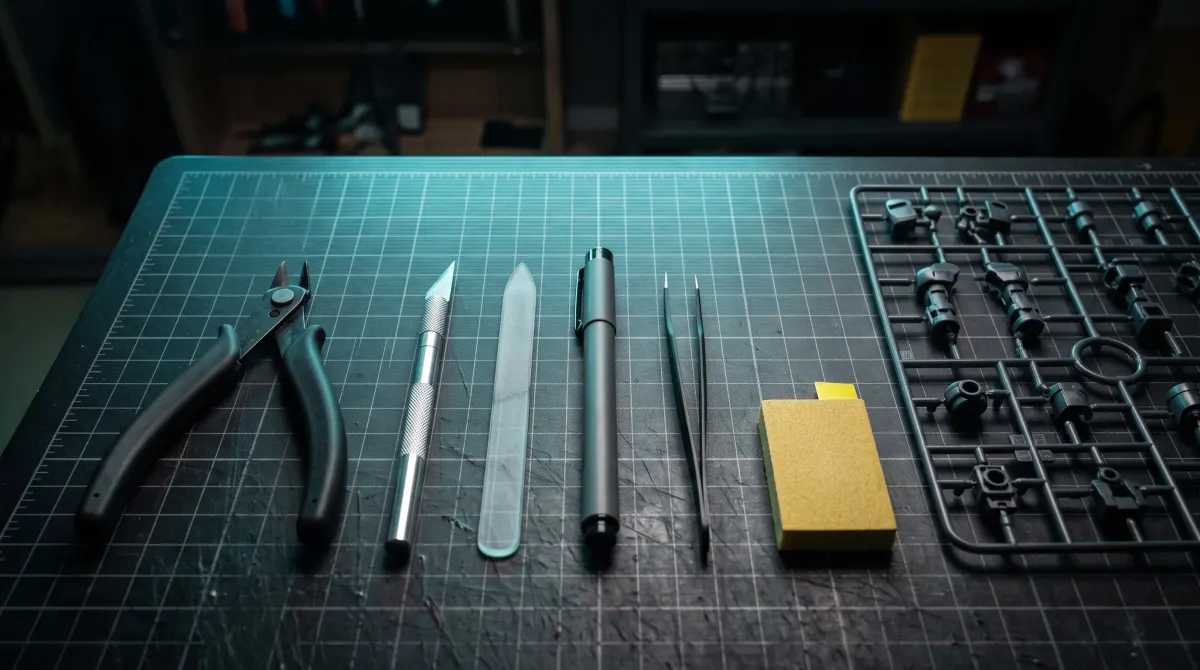
If you buy a single tool before your first Gunpla, make it a pair of plastic model nippers. Snap Fit kits are designed to come apart from the runner by hand, but doing that leaves a visible nub of plastic on every part, and cleaning that nub up with scissors or a butter knife (people really try this) tears the surface and leaves white stress marks that no amount of panel lining hides.
A proper nipper cuts flush to the part in two passes: one close cut, then a second shave right against the surface. You do not need God Hands nippers for your first kit. A budget pair in the $15-35 range, the kind sold specifically for plastic models rather than electronics wire, will get you clean gates and teach you the two-cut habit. Upgrade later once you know what a sharp blade actually feels like against sprue plastic.
A hobby knife, for the nub the nippers leave behind
Even a good flush cut leaves a tiny raised dot where the second cut met the part. A hobby knife with a fresh blade shaves that dot down flat without you needing to sand every single piece. This is where a lot of beginners get impatient and skip straight to sanding, and it works, it is just slower and rougher on small parts.
A basic X-Acto style knife with snap-off or standard blades is enough. Keep the blade sharp. A dull knife is more dangerous than a sharp one because it needs more pressure and slips.
Sanding sticks, for the parts that show
Sanding is where straight builds start looking custom, but it is genuinely optional on kit one. If you want to try it, start with a sanding stick or sponge in the 400 to 600 grit range for knocking down gate marks and mold lines, then move up toward 1000 to 2000 grit if you want a glassy finish before a top coat.
Skip this entirely on your first kit if you want. A clean flush cut with the knife touch-up already looks good under normal lighting. Save sanding for when a mold line on a big flat panel, like a shield or a chest plate, actually bothers you.
A panel line marker, the fastest upgrade in the hobby
This is the tool with the best payoff for the least skill required. A fine-tip panel line marker, gray or brown depending on the kit's base color, run along the recessed lines molded into almost every Gunpla kit adds shadow and depth that makes a plastic model read as a real machine instead of a toy. Wipe the excess off the flat surface with a cotton swab or eraser before it fully dries and you are done in an evening.
The official Gundam Marker line is the standard pick because the tips are made for this exact job, but any fine oil-based marker in a dark neutral color works. This is the one step I tell every new builder to try even if they skip sanding and painting entirely.
Tweezers, for stickers and small parts
You do not strictly need tweezers to build a kit, but the moment you are placing a foil sticker smaller than a fingernail or setting a tiny joint part without leaving fingerprints on it, you will wish you had a pair. Straight, fine-tipped tweezers are enough. Anti-static stainless ones are worth it once you are also handling decals regularly, since static cling is what makes a foil sticker fold on itself mid-placement.
A cutting mat, mostly to protect your table
The actual cutting a Gunpla build needs is light, mostly trimming decals or the rare bit of clean-up with a knife, so a cutting mat is more about not gouging your desk than it is a precision tool. A basic self-healing mat from any craft store works fine and doubles as a grippy, non-slip surface for holding small parts steady.
What you do not need yet
Top coat spray, an airbrush, putty, and a full paint rack are all real upgrades eventually, but none of them belong on a first-kit shopping list. Top coat protects panel lining and cuts down on plastic shine, which matters more once you are lining regularly. Paint and an airbrush are a different hobby layered on top of this one, worth it when you actually want custom colors rather than out-of-the-box plastic.
If you would rather skip tools completely for a build or two while you decide whether this hobby is for you, Entry Grade kits are built for exactly that. They are Snap Fit with minimal nubs and forgiving tolerances, so a bare-hands build still looks decent. Check our Entry Grade guide for kits that hold up fine with zero tools at all.
Nippers, a hobby knife, and a panel line marker cover almost everything a first Gunpla build needs, and sanding, tweezers, and a cutting mat can wait until you know you like this hobby.
Common questions
Can I build Gunpla with no tools at all?
Yes, especially with Entry Grade or High Grade kits. You will have visible nub marks where parts were cut from the runner, but the kit will hold together and pose fine. Nippers are the first upgrade worth making.
Do I need paint to make Gunpla look good?
No. A clean nipper cut plus a panel line marker gets most kits looking sharp with zero painting. Paint and an airbrush are a later-stage upgrade, not a starting requirement.
What is the single best first tool purchase?
Plastic model nippers. They fix the most visible beginner problem, rough white nub marks, in a way no other tool does as directly.
Are expensive nippers worth it for a first kit?
Not yet. A budget pair made for plastic models teaches you the flush-cut technique fine. Save the premium nippers for once you know you are building regularly.