 Guide
GuideDo You Need Tools for Gunpla?
I get asked this a lot from people staring at their first kit box wondering if they need to drop money on hobby tools before they even snap a single part together. The honest answer is it depends entirely on what grade you picked up.
If you grabbed an Entry Grade kit, you can build the whole thing with nothing but your hands. If you picked up a High Grade, Real Grade, or Master Grade, you technically can still go tool-free, but you are going to pay for it later in ways that are hard to undo.
Let me walk through what each path actually looks like so you can decide before you start twisting plastic.
Entry Grade: genuinely no tools needed
Bandai built Entry Grade kits specifically so a first-timer could open the box and go. The parts count stays low, the runners are simplified, and the connection points between each piece and its runner are thin enough that you can pop most of them free with your fingers alone. No exaggeration here, this is one of the only grades where 'no tools' is a fair claim rather than a technicality.
If you are testing whether this hobby is for you, or building with a kid, starting on an Entry Grade with zero tools is a completely reasonable way to spend your first evening. You will not be fighting the kit, and you will not need to buy anything first.
What twisting parts off actually does to the plastic
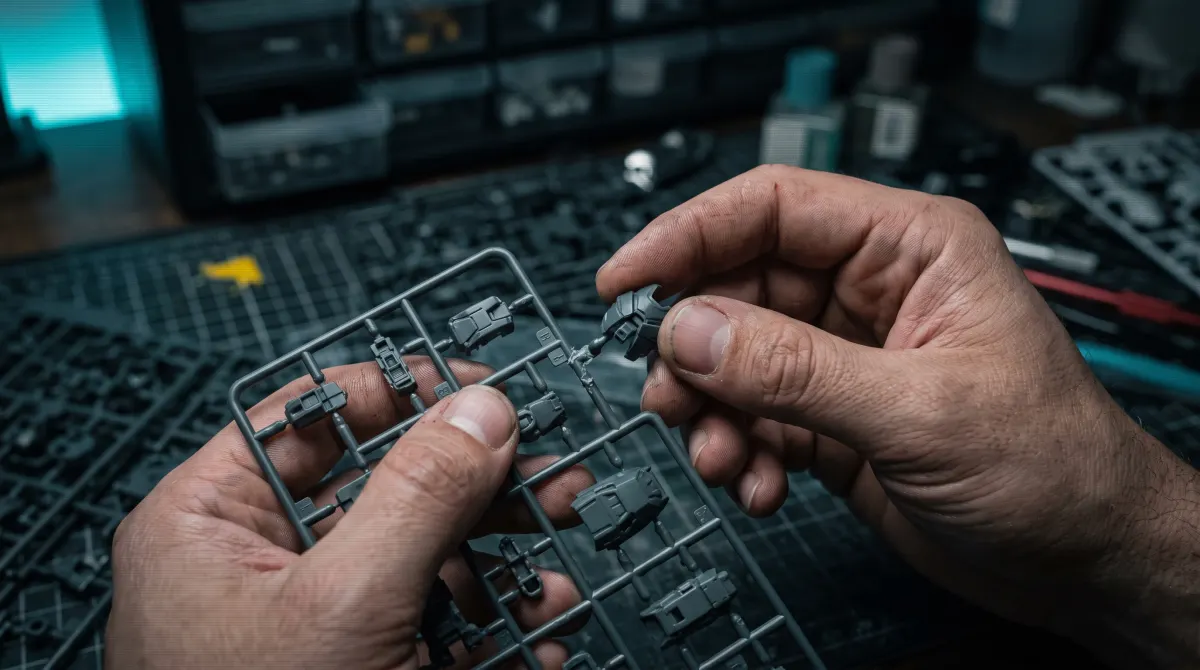
Once you move past Entry Grade, the runner connection points get more numerous and are placed with less forgiveness. Twist a part free by hand and the stress does not travel in a clean line, it tears. That tear pulls a chunk of plastic away from wherever it happened to separate, which is almost never the exact spot the mold intended.
The result is a nub, a small raised stub or a rough divot sitting right on a visible surface. On a flat panel or an edge that faces outward, that nub catches light and reads as a scratch or a chip from a few feet away. It does not sand out easily without leaving its own flat, dull patch, and it is the single most common thing that makes an otherwise careful build look unfinished.
The one tool that changes everything
A pair of gunpla-specific nippers solves this almost entirely. The idea is simple: you cut close to the runner first, leaving a small stub on the part, then you go back and shave that stub down flush in a second pass. Two cuts instead of one twist, and the plastic separates cleanly instead of tearing.
This is the one purchase I would tell any new builder to make before their second kit. It costs less than most single kits and it is the difference between parts that look molded that way and parts with visible damage. You do not need anything fancy for your first pair, just something marketed for plastic model kits rather than general hobby wire cutters, since those leave a much larger and rougher stub behind.
So what do you actually need, grade by grade
For Entry Grade, your hands are enough. For High Grade, Real Grade, and Master Grade, nippers are the realistic minimum if you care how the finished kit looks, since these grades put visible connection points on panel lines, weapons, and joints where a torn nub cannot hide.
Everything past that point, a hobby knife for stubborn nubs, sandpaper or a sanding stick for seam lines, tweezers for small parts and stickers, is genuinely optional and worth adding only once you know you are staying in the hobby. None of it changes whether the kit goes together. It only changes how clean the result looks up close.
My honest take
If someone hands me a kit and no tools, I am not worried about an Entry Grade build. I am worried about anything above it. The parts will still snap together fine either way, gunpla is engineered to be forgiving that way, but a tool-free build on a High Grade or Master Grade is going to have visible tear marks on parts you will look at every day it sits on a shelf.
Start tool-free on an Entry Grade if you want to try the hobby cheap. The moment you move to your second kit at a higher grade, put a basic pair of nippers in your cart alongside it. It is the smallest investment in this hobby that pays off the most.
Entry Grade kits genuinely need no tools, but anything above that grade deserves a basic pair of nippers before you start, or you will be looking at torn nub marks on every part you touch.
Common questions
Can you build a Gunpla kit with no tools at all?
Yes for Entry Grade kits, which are designed for hand separation. For High Grade and above, you can technically force parts off by hand, but you will likely tear visible nub marks into the plastic.
What is the first tool I should buy for Gunpla?
A pair of gunpla-specific side cutters or nippers. They let you cut close to the runner and shave the remaining nub flush, which prevents the torn plastic marks that twisting by hand leaves behind.
Do I need a hobby knife and sandpaper to start?
No. Those help clean up seam lines and stubborn nubs, but they are optional add-ons. Nippers are the only tool that meaningfully changes how your first few kits turn out.