 Guide
GuideGunpla Display Stands: Action Bases Explained
The first time a kit tips over mid pose, you start looking for a stand. It happens to everyone eventually, usually with a kit that has a big weapon or an open wing on one side.
Bandai makes a small family of Action Bases, and they are not interchangeable in the way the packaging photos make them look. Get the wrong one and your kit either does not fit the peg, or it fits but leans like it is exhausted.
This is a walkthrough of what each Action Base actually does, when a cheap third party stand is fine, and how to get a pose that looks intentional instead of stiff.
The Bandai Action Base lineup, and what actually fits what
Action Base 1 is the original, built around 1/100 scale. It handles Master Grade and No Grade kits comfortably, and it will take 1/144 and SD kits with the right adapter, just with more play in the joint than you'd like.
Action Base 2 was built for 1/144 scale, so High Grade is its home turf. Some First Grade and SD kits work with it too, and a lot of Real Grade and HG Origin kits ship with their own peg adapter sized for this base.
Action Base 4 and Action Base 5 are the newer, more flexible versions of 1 and 2. AB4 covers 1/100, 1/144, and SD in one box, and AB5 does the same job as AB2 but with a sturdier hexagonal platform and a shorter arm that holds heavier HG kits without drooping. If you only buy one stand, AB4 or AB5 is the one to get, since they cover more grades than the original two.
Perfect Grade kits are heavier and taller than anything else in the line, and a standard Action Base arm will bow under that weight over time. Bandai sells a beefier stand built for PG scale, and it is worth the extra cost if you are displaying a PG upright rather than laying it in a case.
Cheap third party stands: when they're fine and when they're not
Third party stands from sellers on Amazon or AliExpress copy the Bandai peg and hex platform almost exactly, and for a static, front facing pose on an HG or RG, most of them hold up fine. The plastic on the ball joint tends to be a little softer than Bandai's, so the arm loosens faster if you keep repositioning the kit.
Where they fall short is on anything with real weight hanging off one side, a big MG with a shield and rifle, or a PG. The cheap arms flex, and a kit that was posed level in the morning can be leaning by evening. For a shelf kit you set once and leave alone, cheap is genuinely fine. For a photo prop you're going to repose every week, spend the extra few dollars on an official base or a well reviewed third party one with a metal reinforced joint.
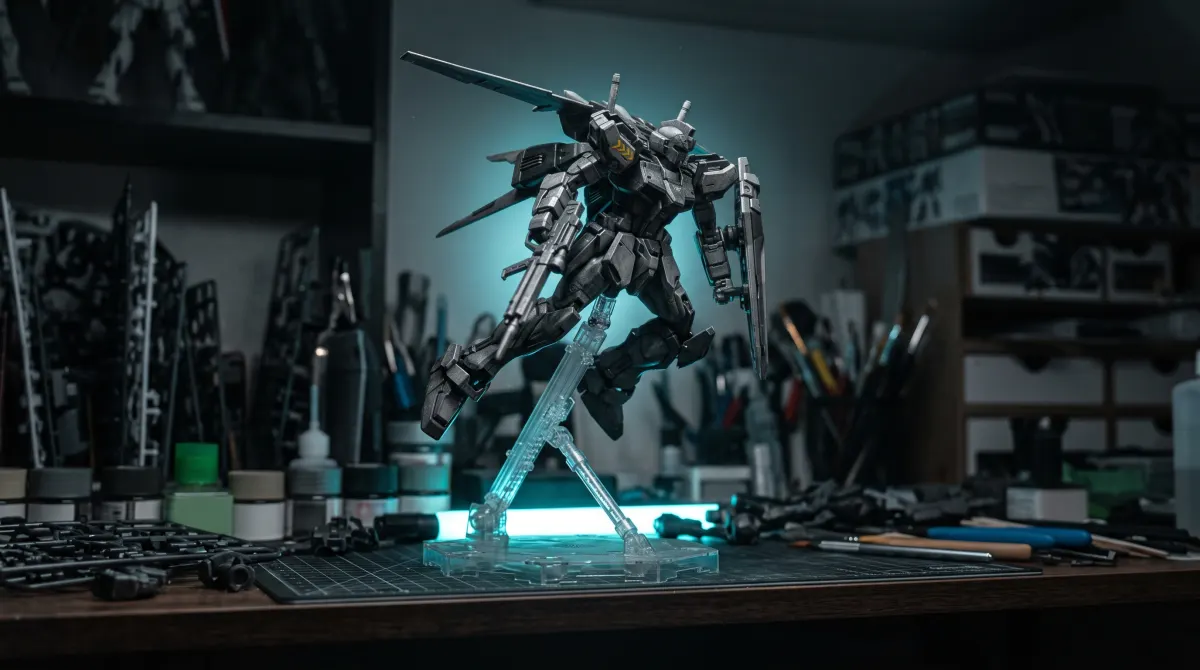
Posing for photos without the stand showing
The peg goes into the kit's back or waist depending on the adapter, and most kits have a dedicated 3mm or 5mm socket for exactly this. Once it is mounted, the trick to a photo that doesn't scream action figure is getting the weight looking believable. Plant the forward foot slightly ahead and let the back foot trail, even though the stand is doing all the actual holding.
Angle the base itself instead of just rotating the kit on the ball joint. A straight-on stand reads as a display shelf. Tilted 15 to 20 degrees off camera, the same pose reads as mid stride. Keep the arm out of frame by shooting from slightly above the kit's waist height rather than dead level, since that's usually where the arm is most visible.
For group shots or dioramas, stagger the stand heights if your base has an adjustable arm, so kits in the back aren't hidden behind kits in front. It is a small thing but it is the difference between a photo that looks staged and one that looks like a scene.
Matching the stand to the kit you already own
If you are not sure which grade a kit is or what scale it was built at, that decides which base you need before anything else. It is worth confirming the grade first, since an RG and an HG both look like 1/144 kits on the shelf but the RG's frame is more delicate and benefits from the sturdier AB5 style platform rather than the older AB2.
Match the Action Base to your kit's grade and scale first, official AB4 or AB5 for most collections, a PG specific stand for Perfect Grade, and save the cheap third party bases for kits you pose once and leave alone.
Common questions
Can one Action Base work for both HG and MG kits?
Action Base 4 is the one built to do both. It ships with adapters for 1/100 and 1/144 pegs, so it covers MG and HG (and most SD) without buying a second stand.
Do Perfect Grade kits need a special stand?
PG kits are heavier and taller than MG or HG, so a standard Action Base arm can sag over time. Bandai's PG scale stand uses a sturdier arm built for that extra weight, and it is worth using if you're displaying the kit upright long term.
Will a third party stand damage my kit's peg hole?
Not usually, since most copy Bandai's peg dimensions closely. The bigger risk is a loose or soft ball joint that lets the kit droop, not damage to the kit itself.