 Guide
GuideRG vs MG: Which Gundam Grade Should You Build?
Every builder hits this fork eventually. You have got money set aside for a kit, you know the suit you want, and now you are staring at a Real Grade box next to a Master Grade box wondering why one costs more and stands half as tall.
I have built plenty of both, and the honest answer is that neither grade is objectively better. They solve different problems. RG packs an unreasonable amount of engineering into a 1/144 scale footprint, while MG gives you room to breathe, more forgiving parts, and a bigger canvas if you ever want to paint or weather the thing.
The cleanest way to settle this for yourself is to look at suits that exist in both grades, since that removes the guesswork about whether a grade upgrade is doing the heavy lifting or the character design is. RX-78-2, Nu Gundam, Wing Zero, and Strike Freedom all have RG and MG releases, so I am using those as the reference points below.
Size and scale
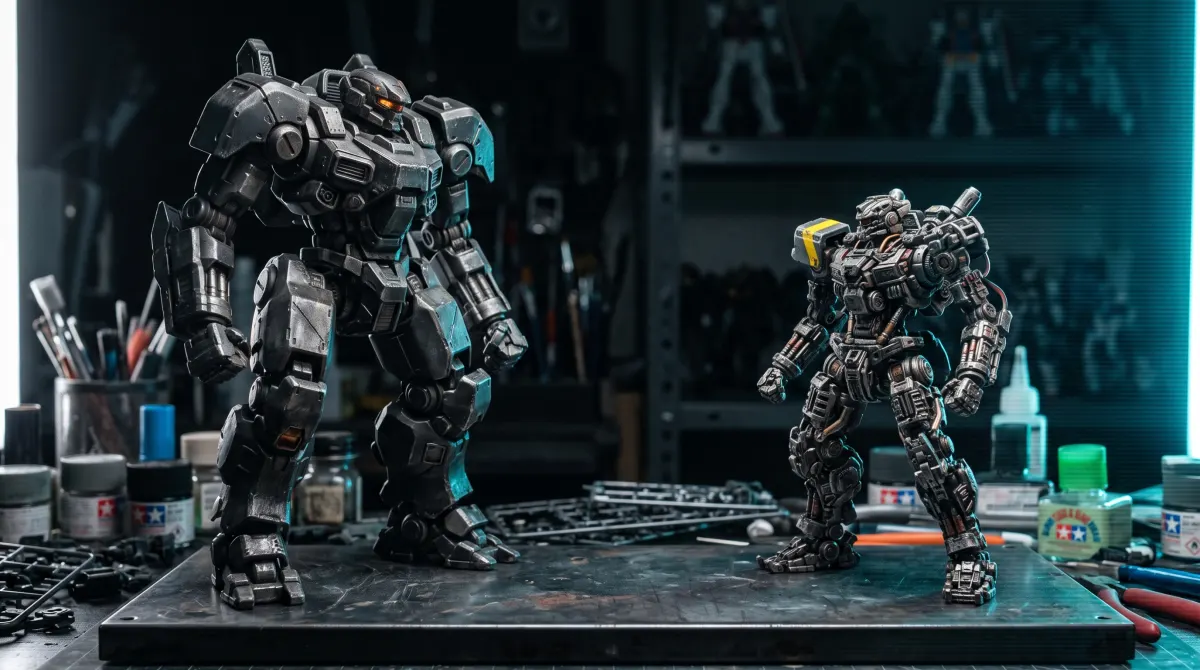
RG is 1/144 scale, the same footprint as a standard HG, which means an RX-78-2 or Strike Freedom RG comes out around 4 to 5 inches tall. MG is 1/100 scale, so the same suit jumps to roughly 7 to 8 inches. That is not a small difference on a shelf. If you are working with limited display space or you like lining up an army of suits, RG lets you fit noticeably more kits in the same footprint. If you want a centerpiece that reads from across the room, MG's extra bulk does real work.
Part count and build complexity
This is where RG surprises people. Because Bandai crams MG-level inner frame detail into a smaller shell, RG kits often carry part counts in the 300 to 450 range, similar to or higher than many MGs, but the individual pieces are smaller and more fragile. Nu Gundam and Wing Zero RG kits in particular have a reputation for tiny, easily lost frame components during the inner skeleton stage.
MG part counts vary a lot by kit and release era, but the pieces themselves tend to be larger and more tolerant of imprecise handling. A newer builder is less likely to snap something on an MG Strike Freedom than on the RG version simply because there is more material to grip.
Articulation and posing
RG's inner frame system genuinely delivers PG-style range of motion in a 1/144 body, and that is the grade's whole pitch. The catch is that some of the polycap joints, especially in older RG releases, are known to feel loose or become stress points over repeated posing. Builders who display a kit once and leave it rarely notice this. Builders who pose their Wing Zero every week eventually do.
MG joints are chunkier and generally hold a pose with more confidence, which matters if you like dynamic action stances or you are shooting photos of the finished build. The tradeoff is that MG range of motion, while excellent, usually falls a step behind what an equivalent RG can hit in a deep knee bend or a tight torso twist.
Paint readiness and customization
MG's larger panel lines, bigger flat surfaces, and more generous part separation make it the friendlier grade for panel lining, custom decals, and airbrush work. There is simply more real estate to work with, and masking small RG parts for a two-tone paint job gets fiddly fast.
RG can absolutely be painted, and a well painted RG Nu Gundam looks fantastic, but expect more time spent on small parts and more care around the inner frame so you do not gum up the articulation with paint buildup. If painting is your main hobby driver rather than just building, I would lean MG for your first custom project and save RG for once you are comfortable working small.
Price and value
RG kits generally land in a lower price bracket than MG kits of the same suit, since they are working with less plastic overall, though the gap has narrowed on newer releases with more runners and gimmicks. For the detail and articulation you are getting per dollar, RG is arguably the better value kit on paper.
MG pricing climbs with kit complexity and can go well beyond RG for suits with heavy gimmicks, transformation features, or included weapon sets. You are paying for the larger scale, the display presence, and often a more relaxed build session rather than a race against tiny parts.
Which one should you actually build first
If you already have a few HG kits under your belt and you want a genuine challenge that rewards patience with a jaw-dropping inner frame, RG is worth the jump, RX-78-2 and Strike Freedom are both solid starting points in that grade. If you are newer to the hobby, want a calmer build session, or plan to paint, start with MG on the same suit and let RG be the upgrade you chase once you trust your hands with small parts.
Pick RG for engineering and shelf efficiency, pick MG for display presence and paint-friendly parts, and if you are unsure, build the same suit in MG first before you try its RG counterpart.
Common questions
Is RG harder to build than MG?
Usually yes, mostly because of part size. RG parts are smaller and easier to stress or lose, even though total part counts between the two grades are often similar.
Does RG look as detailed as MG despite being smaller?
It looks more detailed per square inch thanks to the inner frame and printed decal sheets included with most RG kits, but MG's larger panel lines and bigger accessories give it more presence overall.
Which grade is better for a first paint job?
MG. The bigger flat surfaces and wider panel gaps are far more forgiving for masking and airbrush work than RG's tighter, smaller parts.