 Guide
GuideWhat Is Gunpla? Gundam Model Kits Explained
Gunpla is short for Gundam plastic model, and it is exactly what it sounds like: injection-molded model kits of the robots (mobile suits) from the Gundam franchise, made almost entirely by Bandai. If you have ever seen a fully built, fully colored robot on a shelf and assumed it took an airbrush and years of practice, I want to correct that right now, because it is the single biggest thing that keeps new builders away.
The parts come pre-colored in the plastic itself. You snap them together by hand, off a sprue, following a picture-only instruction booklet, and the result already looks like the box art before you touch a drop of paint or glue. That is the whole trick of the hobby, and it is why Gunpla has stayed approachable for four decades while still having a ceiling high enough for people who paint, weather, and light their kits like museum pieces.
I am not going to walk through every grade line in detail here, that lives on its own page. What I want to do is give you the shape of the hobby: what you are actually building, why it does not require tools or skill to enjoy on day one, and where to go next once you are curious.
What you're actually building
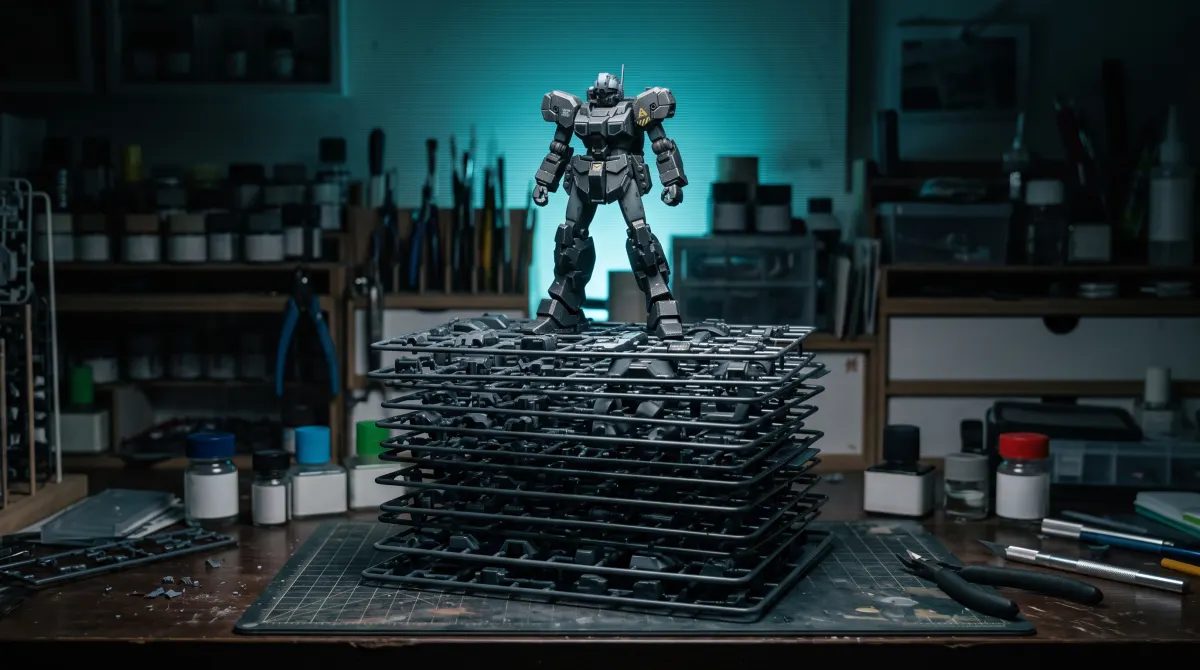
A Gunpla kit is a box of plastic trees called sprues, each holding dozens of small numbered parts still attached by thin gates. You clip or twist a part free, and it snaps onto the next part with a peg and socket, no adhesive involved. Follow the diagrams in order and a few hours later you have a fully articulated mobile suit that can hold a pose, swing a weapon, and stand on its own.
The reason this works without paint is that Bandai molds each sprue in the actual color that part needs to be. A red shoulder piece is molded from red plastic, not painted red afterward. Builders call finishing a kit straight out of the box with no paint, no panel lining, and no extra work a straight build, and a well-designed kit can look genuinely good that way. Everything past that (weathering, custom paint, LEDs, dioramas) is optional, added by builders who want to push further, not a requirement to finish your first one.
Why beginners can start with zero tools
You can build your first kit with nothing but your fingers, and I mean that literally, some people do exactly that. A pair of sprue nippers makes cleanup nicer because it lets you clip parts free without leaving a stub, but plenty of first builds happen with parts twisted off by hand and the nub sanded down later or ignored entirely. There is no glue step to get wrong and no paint to dry, so the barrier that stops people from starting most other model hobbies just is not there for Gunpla.
That low floor is deliberate. Bandai's entry grades exist specifically so a first-time builder can finish in an evening and end up with something that looks like what was on the box, not a frustrating mess that needs rescuing. It is also why the hobby has such a wide age range of builders: the same kit that teaches a ten-year-old their first build is a legitimate weeknight project for an adult who wants to unwind without a screen.
The grade lines, briefly
Bandai sorts Gunpla into a handful of grade lines that trade off scale, part count, articulation, and price, running roughly from Entry Grade and High Grade at the accessible end up through Real Grade, Master Grade, and Perfect Grade for builders who want more engineering and detail packed into the same robot. Each line is its own consistent standard, so an HG kit from one series builds about the same way as an HG kit from another.
I am deliberately not re-explaining every grade's part counts and price bands here, that comparison deserves its own space and gets a proper breakdown on the grades guide linked below. If you are brand new, the short version is: start High Grade, it is the grade the rest of the hobby is built around.
What it costs to get started
An entry-level kit runs somewhere in the range most hobbies would call an impulse buy, and the only other thing you truly need is a flat surface and some patience. Everything else, nippers, a hobby knife, panel-lining pens, top coat, is a later purchase you make once you know you like the hobby, not a prerequisite to trying it.
This is different from a lot of hobbies that front-load cost before you know if you will stick with it. Gunpla lets you buy one kit, build it in an afternoon, and decide from a finished result in your hands whether you want a second one.
Gunpla is the Gundam model kit hobby built around snap-fit, pre-colored parts, so your very first kit can look right straight out of the box with no glue, paint, or tools required.
Common questions
Do you need to paint Gunpla kits?
No. Parts are molded in the correct color, so a straight build with no paint still looks accurate to the box art. Painting is an optional step builders add later for a more refined finish.
Is Gunpla the same as Gundam?
Gundam is the anime and media franchise. Gunpla is the plastic model kit hobby built around it, almost entirely made by Bandai, covering mobile suits from every Gundam series.
What grade should a beginner start with?
High Grade (HG). It is the most common, most affordable, and quickest to build, and it is the grade most other Gunpla content assumes you already know.
Do you need special tools to build your first kit?
No. Parts snap together by hand. A pair of sprue nippers makes part removal cleaner, but plenty of first builds are finished with nothing but fingers.